Last week I was putting together my syllabus for a year-long American literature course I'll be teaching to ninth and tenth graders at a homeschool co-op starting in the fall, my favorite genre. There are so many wonderful things I've considered including that I needed advice and perspective from others to help me make sure I wasn't overloading the class. So I tossed the question out on Facebook to find out people's favorite and least favorite books they read in high school. For my purposes this time I threw out everything that wasn't American lit and made my choices from the feedback I got.
Did you see Silver Linings Playbook a few months ago when it was out? I loved the complex characters, plot and the balance between funny and serious moments throughout the film. I thought Bradley Cooper as the main character Pat was wonderful. While I liked him just fine in The Hangover and Wedding Crashers, I loved seeing what else he could do.
I just read the book version by Matthew Quick earlier this week. There are some big differences between the book and the movie, but I liked each of them for different reasons. In both the book and the movie Pat is trying to win back his ex-wife by getting in shape and reading everything she has put on the syllabus for her high school English students. Though he doesn't love what she's selected, he plows through them, looking forward to the day when he'll be reunited with his ex-wife and they can discuss the novels.
Two-thirds of the books Pat reads are ones I've chosen for my syllabus: The Great Gatsby, A Farewell to Arms, The Scarlet Letter and Huckleberry Finn. The two Pat read that I didn't pick are The Catcher in the Rye (which almost made it on to the syllabus. If I teach this class again I might teach this one.) and The Bell Jar.
Here are the rest of the novels that made it in: My Antonia, Of Mice and Men and The Color Purple. We'll also read A Streetcar Named Desire and bits and pieces of Phyllis Wheatley, Anne Bradstreet, Thoreau, Whitman, Emerson, Sandburg and Dickinson. I'm looking forward to rereading all these classics myself to prepare.
Have I missed anything What other books do you consider to be important to American literature?
Showing posts with label New Orleans. Show all posts
Showing posts with label New Orleans. Show all posts
Friday, June 14, 2013

Friday, December 28, 2012
Recent Read: Isaac's Storm
I've just finished reading the fascinating Erik Larson book Isaac's Storm: A Man, A Time, and the Deadliest Hurricane in History. Having, along with the rest of the country, just recently taken in all the Hurricane Sandy news coverage, it was really interesting to read this book now. Plus, I'm just interested in hurricanes and how they impact people, having done some post-Katrina cleanup in Mississippi in 2005 and 2006, and experiencing Fran (1996) and Floyd (1999) while I lived in North Carolina.
Larson, as he always does, re-creates dialogue and description that amazes me, since most of the time his subject matter deals with the past far enough back that interviews with those who experienced these things first hand is impossible. The descriptions of the water surge during the Galveston hurricane of 1900 were what I'm still thinking about a few days after finishing reading the book. The vivid descriptions of homeowners chopping holes in their beautiful wood floors to give the water somewhere to go in the Galveston hurricane seemed eerily like see footage from Katrina homeowners who'd had to punch out through their roofs to wait for help to come.
Also, in light of Sandy's recent devastation, it's interesting to consider how people in New York and New Jersey faired when they had a week or so of preparation time versus those who faced the 1900 hurricane with little to no warning. Those in Sandy's path could make the choice to evacuate and access to some resources (cell phones, proximity to emergency services, FEMA, organizations like the Baptist North American Mission Board to provide things like laundry services, hot meals, chainsaw teams and crisis counseling). And it was still was (and still is I'm sure) a frustrating experience for homeowners to not be able to get what they needed exactly when they needed it. Those affected by the Galveston hurricane didn't have appropriate weather information, the ability to communicate easily with their loved ones after the storm, a proper and dignified way to handle the bodies of those who did not survive the storm.
Reading Isaac's Storm also made me think back to books I've read fairly recently about Katrina: Zeitoun and Nine Lives: Mystery, Magic, Death, and Life in New Orleans. It's a lot to think about.
Larson, as he always does, re-creates dialogue and description that amazes me, since most of the time his subject matter deals with the past far enough back that interviews with those who experienced these things first hand is impossible. The descriptions of the water surge during the Galveston hurricane of 1900 were what I'm still thinking about a few days after finishing reading the book. The vivid descriptions of homeowners chopping holes in their beautiful wood floors to give the water somewhere to go in the Galveston hurricane seemed eerily like see footage from Katrina homeowners who'd had to punch out through their roofs to wait for help to come.
Also, in light of Sandy's recent devastation, it's interesting to consider how people in New York and New Jersey faired when they had a week or so of preparation time versus those who faced the 1900 hurricane with little to no warning. Those in Sandy's path could make the choice to evacuate and access to some resources (cell phones, proximity to emergency services, FEMA, organizations like the Baptist North American Mission Board to provide things like laundry services, hot meals, chainsaw teams and crisis counseling). And it was still was (and still is I'm sure) a frustrating experience for homeowners to not be able to get what they needed exactly when they needed it. Those affected by the Galveston hurricane didn't have appropriate weather information, the ability to communicate easily with their loved ones after the storm, a proper and dignified way to handle the bodies of those who did not survive the storm.
Reading Isaac's Storm also made me think back to books I've read fairly recently about Katrina: Zeitoun and Nine Lives: Mystery, Magic, Death, and Life in New Orleans. It's a lot to think about.
Saturday, May 19, 2012
A Note on Some New Orleans Reading
About a year ago I read two books about Hurricane Katrina's effect on New Orleans and blogged about them: The House on First Street: My New Orleans Story by Julia Reed and Zeitoun by Dave Eggers. I meant to point this out a long time ago, but I was quite amused when I realized that Zeitoun, the owner of a painting company, recounts painting the interior of Reed's house on First Street (if ever remodeling a house was a nightmare, then surely hers was). Both Reed and Eggers identify the house by saying it's directly across the street from writer Anne Rice's Garden District home.
Reed: "...I was so irritated that I...scribbled...[a] very profane message to the painters that immediately became legend....They dutifully sanded down the powder room and reapplied its pretty, rich red, but not just on the walls - they painted the woodwork, the ceiling, everything. The effect was like being inside a bloodbath and I was ready for one. Instead, I marched out of the house, removed the paint contractor's sign from our iron fence, threw it in the middle of First Street, and stomped on it repeatedly" (p. 39).
Eggers: "High ceilings, a grand winding staircase descending into the foyer, hand-carved everything, each room themed with a district character. Zeitoun had painted and repainted probably every room in the house, and the owners showed no signs of stopping" (p. 21).
I can't say that Zeitoun's company is the one that had to redo Reed's bathroom, or if his company was called in to fix what went wrong with the first painters. Interesting, though, that the books reference this same house.
Reed: "...I was so irritated that I...scribbled...[a] very profane message to the painters that immediately became legend....They dutifully sanded down the powder room and reapplied its pretty, rich red, but not just on the walls - they painted the woodwork, the ceiling, everything. The effect was like being inside a bloodbath and I was ready for one. Instead, I marched out of the house, removed the paint contractor's sign from our iron fence, threw it in the middle of First Street, and stomped on it repeatedly" (p. 39).
Eggers: "High ceilings, a grand winding staircase descending into the foyer, hand-carved everything, each room themed with a district character. Zeitoun had painted and repainted probably every room in the house, and the owners showed no signs of stopping" (p. 21).
I can't say that Zeitoun's company is the one that had to redo Reed's bathroom, or if his company was called in to fix what went wrong with the first painters. Interesting, though, that the books reference this same house.
Monday, November 28, 2011
New Orleans Reading
I've been on a New Orleans reading streak. It began with Robert Hicks' A Separate Country , then moved to Zeitoun
  by Dave Eggers, and finished with Dan Baum's Nine Lives: Mystery, Magic, Death, and Life in New Orleans
 .
.
Earlier this year I talked about Hicks' first book, The Widow of the South , and his second novel, A Separate Country, is a nice follow up to his first, and like his first, it is historical fiction based on truth. In it, a soldier named Eli Griffin who appeared in Widow returns as a trusted friend to Confederate General John Bell Hood. Both men are living in New Orleans. Hood settled there after the war, met and married his wife, and raised 11 children with her. Hood and his wife, Anna Marie, have both contracted the same disease and are near death when Hood sends for Eli. Hood instructs him to find a man named Sebastian Lemerle and to publish his memoirs which he has handwritten. Eli agrees and returns to the house after he hears of Hood's passing a few days later. At the house he finds another memoir of sorts written by Anna Marie for Lydia, the couple's oldest daughter. Eli narrates us through his reading of both of these works and we realize the complications of the Hoods' marriage. In the book, readers meet colorful characters and learn a little about honor from several of the characters including Eli, who is determined to carry out Hood's last wishes.
New Orleans is a wonderful, intriguing, mysterious place unlike any other. It is that today as it was while the Hoods were living there. In her journal in A Separate Country, Anna Marie writes to Lydia, "I hope that you never leave this city. I hope you will love it as I have, imperfectly, inconstantly, but passionately....There has been little for me but this city. I wonder if I could breathe the air outside New Orleans, whether I would drown....I am glad of this place only because I could not survive anywhere else."
Zeitounis a much more modern book written about the days before, after and during Hurricane Katrina in New Orleans in 2005. Abdulrahman Zeitoun is the central character. He, too, struggles with his adopted city and country during the days after Hurricane Katrina's devastation along the Gulf Coast. As a business owner, he is hesitant to evacuate and leave his property for the storm. His wife and four children leave without him first for Baton Rouge and then for Arizona.
Zeitoun's need to remain with New Orleans, though, is rooted more deeply than just out of concern for his business. On his first day paddling around his neighborhood in his canoe, he begins rescuing people who are trapped in their homes and dropping them on higher ground where they can get help. At the end of that first day Zeitoun knows "...there would be more to do tomorrow. How would he explain to Kathy, to his brother Ahmad, that he was so thankful he had stayed in the city? He was certain he had been called to stay, that God knew he would be of service if he remained. His choice to stay in the city had been God's will."
A few months ago when I blogged about my disappointment that Julia Reed's The House on First Street: My New Orleans Story wasn't the post-Katrina/resilience/rebuilding story I'd hoped for. While I realize that for an area to bounce back after a natural disaster, all sorts of things come into play, and that New Orleans is a city focused heavily on the tourism industry and a partying atmosphere, I really wanted to read about the "regular" people who faced adversity in getting back on their feet after the storm, whether the end result was 100% triumphant or not. Luckily, a reader suggested Zeitoun as a read more like what I was looking for. It was. Though I wasn't bowled over by fantastic writing, it was a compelling story, especially after some of the background information on Zeitoun and his family were out of the way and the storm hit.
Just as I remember watching CNN in August and September of 2005 in disappointment that such chaos and disorder was even possible in the United States, I read this book with disappointment that even though we live in a great nation, we still don't live in a place where people who are perceived by some as being "different" can be left to live their lives in peace. It was an eye-opening story that needed to be written. I'm glad Eggers brought attention to this family's story.
Just as Zeitounwas an eye-opening book, so was Baum's Nine Lives: Mystery, Magic, Death, and Life in New Orleans. The author recreates the lives of nine New Orleans residents from Hurricane Betsy in 1965 through Katrina in 2005. It covered the ins and outs of Mardi Gras for the different neighborhoods in the city and showed the variety of life experiences had by these residents of varied genders, races, cultures and socioeconomic backgrounds. Parts of this book, like Zeitoun, were particularly heartbreaking. I remember hearing in the media during Katrina's aftermath that corpses could not be collected promptly, and police officers reached the breaking point, and in some cases simply walked away from their jobs. All the things I was horrified to hear about in 2005 were spelled out in this book by characters who experienced them first hand.
From this New Orleans reading trifecta, I'm still convinced that New Orleans is one of the weirdest and most wonderful places on earth. Reading about it helps me understand better how so many things went wrong after Katrina and why New Orleanians are so resilient. I highly recommend Zeitounand Nine Lives: Mystery, Magic, Death, and Life in New Orleans for Katrina stories, and if you're into history, you'll probably like A Separate Country. Three fantastic reads.
, then moved to Zeitoun by Dave Eggers, and finished with Dan Baum's Nine Lives: Mystery, Magic, Death, and Life in New Orleans.Earlier this year I talked about Hicks' first book, The Widow of the South
, and his second novel, A Separate Country, is a nice follow up to his first, and like his first, it is historical fiction based on truth. In it, a soldier named Eli Griffin who appeared in Widow returns as a trusted friend to Confederate General John Bell Hood. Both men are living in New Orleans. Hood settled there after the war, met and married his wife, and raised 11 children with her. Hood and his wife, Anna Marie, have both contracted the same disease and are near death when Hood sends for Eli. Hood instructs him to find a man named Sebastian Lemerle and to publish his memoirs which he has handwritten. Eli agrees and returns to the house after he hears of Hood's passing a few days later. At the house he finds another memoir of sorts written by Anna Marie for Lydia, the couple's oldest daughter. Eli narrates us through his reading of both of these works and we realize the complications of the Hoods' marriage. In the book, readers meet colorful characters and learn a little about honor from several of the characters including Eli, who is determined to carry out Hood's last wishes.New Orleans is a wonderful, intriguing, mysterious place unlike any other. It is that today as it was while the Hoods were living there. In her journal in A Separate Country
, Anna Marie writes to Lydia, "I hope that you never leave this city. I hope you will love it as I have, imperfectly, inconstantly, but passionately....There has been little for me but this city. I wonder if I could breathe the air outside New Orleans, whether I would drown....I am glad of this place only because I could not survive anywhere else."Zeitoun
is a much more modern book written about the days before, after and during Hurricane Katrina in New Orleans in 2005. Abdulrahman Zeitoun is the central character. He, too, struggles with his adopted city and country during the days after Hurricane Katrina's devastation along the Gulf Coast. As a business owner, he is hesitant to evacuate and leave his property for the storm. His wife and four children leave without him first for Baton Rouge and then for Arizona.Zeitoun's need to remain with New Orleans, though, is rooted more deeply than just out of concern for his business. On his first day paddling around his neighborhood in his canoe, he begins rescuing people who are trapped in their homes and dropping them on higher ground where they can get help. At the end of that first day Zeitoun knows "...there would be more to do tomorrow. How would he explain to Kathy, to his brother Ahmad, that he was so thankful he had stayed in the city? He was certain he had been called to stay, that God knew he would be of service if he remained. His choice to stay in the city had been God's will."
A few months ago when I blogged about my disappointment that Julia Reed's The House on First Street: My New Orleans Story
wasn't the post-Katrina/resilience/rebuilding story I'd hoped for. While I realize that for an area to bounce back after a natural disaster, all sorts of things come into play, and that New Orleans is a city focused heavily on the tourism industry and a partying atmosphere, I really wanted to read about the "regular" people who faced adversity in getting back on their feet after the storm, whether the end result was 100% triumphant or not. Luckily, a reader suggested Zeitoun as a read more like what I was looking for. It was. Though I wasn't bowled over by fantastic writing, it was a compelling story, especially after some of the background information on Zeitoun and his family were out of the way and the storm hit.Just as I remember watching CNN in August and September of 2005 in disappointment that such chaos and disorder was even possible in the United States, I read this book with disappointment that even though we live in a great nation, we still don't live in a place where people who are perceived by some as being "different" can be left to live their lives in peace. It was an eye-opening story that needed to be written. I'm glad Eggers brought attention to this family's story.
Just as Zeitoun
was an eye-opening book, so was Baum's Nine Lives: Mystery, Magic, Death, and Life in New Orleans. The author recreates the lives of nine New Orleans residents from Hurricane Betsy in 1965 through Katrina in 2005. It covered the ins and outs of Mardi Gras for the different neighborhoods in the city and showed the variety of life experiences had by these residents of varied genders, races, cultures and socioeconomic backgrounds. Parts of this book, like Zeitoun, were particularly heartbreaking. I remember hearing in the media during Katrina's aftermath that corpses could not be collected promptly, and police officers reached the breaking point, and in some cases simply walked away from their jobs. All the things I was horrified to hear about in 2005 were spelled out in this book by characters who experienced them first hand.From this New Orleans reading trifecta, I'm still convinced that New Orleans is one of the weirdest and most wonderful places on earth. Reading about it helps me understand better how so many things went wrong after Katrina and why New Orleanians are so resilient. I highly recommend Zeitoun
and Nine Lives: Mystery, Magic, Death, and Life in New Orleans for Katrina stories, and if you're into history, you'll probably like A Separate Country. Three fantastic reads.
Wednesday, October 26, 2011
First Chapter - First Paragraph

Every Tuesday, Bibliophile by the Sea participates in First Chapter - First Paragraph: Tuesday Intros, and today I am too.
I choose my current read, A Separate Country: A Story of Redemption in the Aftermath of the Civil War
 by Robert Hicks:
To participate in First Chapter ~ First Paragraph, visit Diane's blog at Bibliophile By the Sea.
Tuesday, May 31, 2011
New Orleans' Literary Scene
Recently my husband and I celebrated our anniversary with a long weekend in New Orleans, and I'm not sure whether I was more excited about the food I was planning to eat or seeing the city where many great writers have penned their famous works. We spent three and a half days mostly in the French Quarter and I tracked down all the places I could find with literary significance. Here they are:
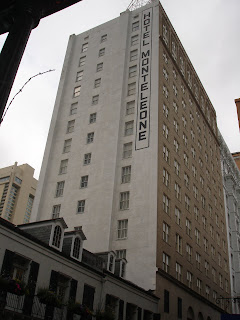

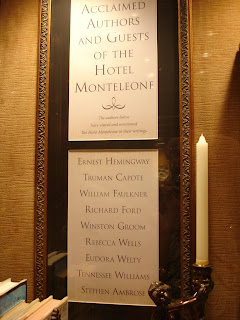

Hotel Monteleone has been visited by many important writers (see photo above for list). It's a beautiful hotel, and if you sit in the Carousel Bar near the window overlooking Royal Street, the people watching is top-notch.

Here I am on the St. Charles Avenue Streetcar. I was so excited thinking about Tennessee Williams' A Streetcar Named Desire that I could barely contain myself.
 William Faulkner lived in this townhouse just off Jackson Square in his early years as a writer. He wrote Mosquitoes
  and Soldier's Pay
 while he stayed here. As bookstores go, this one is pretty small, but so filled with great stuff you hardly even notice. I bought three books here that I'll likely be writing about after I've read them later.

This home on Bourbon Street was occupied at different times by both Truman Capote and Tennessee Williams. Now it's owned by Cokie Roberts' mother, Lindy Boggs, a politician and activist.

This home on St. Peter Street is where Williams wrote A Streetcar Named Desire.
 And finally, this is Galatoire's, a French restaurant on Bourbon Street frequented by Tennessee Williams. Also, Stella took Blanche here in A Streetcar Named Desire. We ate here and the food was good, but many of the places we ate were much better than good.
My self-guided tour of New Orleans was satisfactory, but it was merely a substitute for a real one I'd tried to line up. There is just one literary tour in town and though the woman who gives them is supposed to be fantastic, she doesn't return phone calls and even hangs up on people calling at an inconvenient time for her (she has, apparently, never heard of voicemail). My suggestion to New Orleans is that someone else needs to give her some competition. New Orleans is far too important to American literature to only have one person telling all the good stuff. OK, the gripe session is over now.



Hotel Monteleone has been visited by many important writers (see photo above for list). It's a beautiful hotel, and if you sit in the Carousel Bar near the window overlooking Royal Street, the people watching is top-notch.

Here I am on the St. Charles Avenue Streetcar. I was so excited thinking about Tennessee Williams' A Streetcar Named Desire
that I could barely contain myself. and Soldier's Pay while he stayed here. As bookstores go, this one is pretty small, but so filled with great stuff you hardly even notice. I bought three books here that I'll likely be writing about after I've read them later.
This home on Bourbon Street was occupied at different times by both Truman Capote and Tennessee Williams. Now it's owned by Cokie Roberts' mother, Lindy Boggs, a politician and activist.

This home on St. Peter Street is where Williams wrote A Streetcar Named Desire.

My self-guided tour of New Orleans was satisfactory, but it was merely a substitute for a real one I'd tried to line up. There is just one literary tour in town and though the woman who gives them is supposed to be fantastic, she doesn't return phone calls and even hangs up on people calling at an inconvenient time for her (she has, apparently, never heard of voicemail). My suggestion to New Orleans is that someone else needs to give her some competition. New Orleans is far too important to American literature to only have one person telling all the good stuff. OK, the gripe session is over now.
Monday, May 2, 2011
Disappointing Post-Katrina Read
In light of an upcoming trip to New Orleans, I'd really been looking forward to reading a book I'd heard about by Julia Reed called The House on First Street: My New Orleans Story . Reed is a writer who had never put solid roots down anywhere for about 20 years when she decided to marry and buy a fixer upper in the Garden District. The house had once been very grand and needed a lot of work, which the couple started with the hire of a general contractor and a host of laborers only four weeks before Hurricane Katrina made landfall along the Gulf Coast. All of that sounds interesting, right? Here's where I began to grow frustrated. While I enjoyed the funny anecdotes at the beginning of the book, and Reed's writing style throughout, at some point my opinion turned and I started to not like her New Orleans story so much.
I remember very well watching all the coverage of Hurricane Katrina and its aftermath back in 2005. The weekend after the storm when the levees had broken in New Orleans and the chaos was just heartbreaking and unbelievable, a friend was visiting me for the weekend. We absolutely could not turn away from the reports on CNN. I won't ever forget the images of people and animals being lifted from rooftops by helicopter, those unfortunate people waiting for help along the bridge and the terrible reports that were coming out of the Superdome. Each image of a demolished house with spray painting indicating that it had been checked for bodies was haunting.
Reed only touches on these things likely because she didn't have these experiences. First, she and her husband were luckier than many New Orleans residents in that they owned a car and had the money to buy gas and had a place to stay elsewhere. Second, she and her husband have connections all over Louisiana and Mississippi, and I will say that they used those connections for good. However, I realized at some point that Reed was more focused on dropping the names of all the notable people she associates with in New Orleans and all those people to whom she gave money. Couldn't she have left these things out? When it started to be a focus of the book, and no longer a focus on her beautiful home or the city of New Orleans itself, I lost interest quickly. For example, she starts dropping money like crazy after the storm, helping people who'd worked on her house, been servers at parties she'd thrown over the years, etc. Then, she ordered barbecue enough for 700 National Guard troops who were watching her neighborhood, and she didn't even ask the price. Not to mention all the expense incurred to do over a historic home twice. There's no doubt that she was trying to help those who needed it, but my goodness, did she have to tell us over and over and over again that she gave/sent so-and-so money?
Reed must be friends with nearly every notable person in New Orleans, and she mentioned each one of them by name in the book. A few weeks after the hurricane, Reed tells about all the restaurant reopenings she attended each night as the city was coming back to life. Fun, yes, and I know that's what New Orleans is all about most of the time. But what about all those folks who were still eating meals fixed by church mission teams because that's all they could get?
Don't take this the wrong way. I finished this book just as excited to see New Orleans as I had been before. And I know that everyone is entitled to share his or her story the way he or she experienced it, and Reed has certainly exercised that right in her book. Though I haven't been there before, the media portrays the city as a place of the very poor and the very rich. Reed clearly hangs with the very rich (or at least the very connected), and I think the resilience of the regular folks with less options was more what I wanted to read about. This leaves me with the desire to read something about the regular folks in New Orleans and how they've risen above the destruction. Does anyone have a suggestion for me?
. Reed is a writer who had never put solid roots down anywhere for about 20 years when she decided to marry and buy a fixer upper in the Garden District. The house had once been very grand and needed a lot of work, which the couple started with the hire of a general contractor and a host of laborers only four weeks before Hurricane Katrina made landfall along the Gulf Coast. All of that sounds interesting, right? Here's where I began to grow frustrated. While I enjoyed the funny anecdotes at the beginning of the book, and Reed's writing style throughout, at some point my opinion turned and I started to not like her New Orleans story so much.I remember very well watching all the coverage of Hurricane Katrina and its aftermath back in 2005. The weekend after the storm when the levees had broken in New Orleans and the chaos was just heartbreaking and unbelievable, a friend was visiting me for the weekend. We absolutely could not turn away from the reports on CNN. I won't ever forget the images of people and animals being lifted from rooftops by helicopter, those unfortunate people waiting for help along the bridge and the terrible reports that were coming out of the Superdome. Each image of a demolished house with spray painting indicating that it had been checked for bodies was haunting.
Reed only touches on these things likely because she didn't have these experiences. First, she and her husband were luckier than many New Orleans residents in that they owned a car and had the money to buy gas and had a place to stay elsewhere. Second, she and her husband have connections all over Louisiana and Mississippi, and I will say that they used those connections for good. However, I realized at some point that Reed was more focused on dropping the names of all the notable people she associates with in New Orleans and all those people to whom she gave money. Couldn't she have left these things out? When it started to be a focus of the book, and no longer a focus on her beautiful home or the city of New Orleans itself, I lost interest quickly. For example, she starts dropping money like crazy after the storm, helping people who'd worked on her house, been servers at parties she'd thrown over the years, etc. Then, she ordered barbecue enough for 700 National Guard troops who were watching her neighborhood, and she didn't even ask the price. Not to mention all the expense incurred to do over a historic home twice. There's no doubt that she was trying to help those who needed it, but my goodness, did she have to tell us over and over and over again that she gave/sent so-and-so money?
Reed must be friends with nearly every notable person in New Orleans, and she mentioned each one of them by name in the book. A few weeks after the hurricane, Reed tells about all the restaurant reopenings she attended each night as the city was coming back to life. Fun, yes, and I know that's what New Orleans is all about most of the time. But what about all those folks who were still eating meals fixed by church mission teams because that's all they could get?
Don't take this the wrong way. I finished this book just as excited to see New Orleans as I had been before. And I know that everyone is entitled to share his or her story the way he or she experienced it, and Reed has certainly exercised that right in her book. Though I haven't been there before, the media portrays the city as a place of the very poor and the very rich. Reed clearly hangs with the very rich (or at least the very connected), and I think the resilience of the regular folks with less options was more what I wanted to read about. This leaves me with the desire to read something about the regular folks in New Orleans and how they've risen above the destruction. Does anyone have a suggestion for me?
Friday, April 2, 2010
Stella!!!
The 24th annual Tennessee Williams/New Orleans Literary Festival ended last week. This is an event I'd love to attend one day (or for that matter, just visit New Orleans at any time), but for now I'll have to settle for watching online videos of the Stella Shouting Contest, which is pretty great. Here's the link.
I've finally finished reading a book I mentioned over a month ago, Where Peachtree Meets Sweet Auburn: A Saga of Race and Family by Gary Pomerantz. It was pretty interesting with lots of good information, but DENSE. It took me a lot longer to read than most other books, but it was worth it. I learned a lot about Atlanta, which is great, since I really didn't know enough before. I'm happy I read it, but also happy to move on to something else. Tomorrow I'll be starting Carson McCullers' The Heart is a Lonely Hunter, which I'm very excited about because I hope to visit her childhood home in Columbus, Georgia, later this month. I'll keep you posted.
I've finally finished reading a book I mentioned over a month ago, Where Peachtree Meets Sweet Auburn: A Saga of Race and Family by Gary Pomerantz. It was pretty interesting with lots of good information, but DENSE. It took me a lot longer to read than most other books, but it was worth it. I learned a lot about Atlanta, which is great, since I really didn't know enough before. I'm happy I read it, but also happy to move on to something else. Tomorrow I'll be starting Carson McCullers' The Heart is a Lonely Hunter, which I'm very excited about because I hope to visit her childhood home in Columbus, Georgia, later this month. I'll keep you posted.
Subscribe to:
Posts (Atom)